
Shakesbear
Image
1

At the beginning of December the Royal Court created a series of ‘microplays’ in conjunction with The Guardian. Some were a bit hit or miss, but one really stood out as being great example of what you could achieve in just five minutes.
The piece was entitled Groove Is In The Heart. I loved that it evoked so many emotions through the use of very little language and instead played on the audiences associations with music and how one song can create such a vivid memory of someone. To me the story was straightforward (he is about to go to her funeral) but the comments section offered up a couple of other explanations I hadn’t thought of. It just goes to show how we can each interpret something different from a film/play, even if it is only five minutes long.
I have been involved in and watched a lot of ‘short play’ evenings, however when a play on stage is only five minutes long it often doesn’t quite involve the audience enough for them to really care about it. However when a film is just five minutes in length it can be enough for an audience to become totally engrossed in a story. It makes me wonder if there would be any way for a very short play to have the same impact as a short film like the one above? Music is often quite a difficult thing to get ‘right’ on stage and can come across as intrusive, so words become the main medium playwrights can use to tell a story – which can mean that not much is left open to interpretation. I’d be very interested to know if anyone has seen a very short play that they’ve really enjoyed, and if so what made it work particularly well as a five minute piece onstage – comments as always very much encouraged and appreciated! I’d love to have a discussion about this and hear opinions 🙂
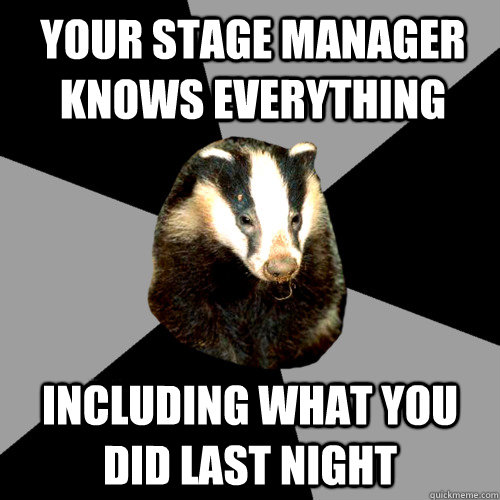
My new favourite meme! Lots of love for the backstage crew 🙂
Last week a story popped up multiple times on my Facebook newsfeed. It was an article from The Stage regarding the average wage for freelance directors in the UK. Link is here, please do read as it is absolutely worth it.
I took a guess that if a freelance director was doing reasonably well i.e. only doing paid work throughout the year, then they might reasonably be earning on average £20,000. And this was taking into account that theatre work is often unpredictable, particularly if you are freelancing on each job. So imagine my horror when I saw that theatre directors in the UK on average only earn £10,759 per year! Along with this over half that responded to the survey earned under £5,000 per year.
It takes an awful lot of work, luck and contacts to secure a directing gig at one of London’s top theatre’s, say at The Donmar or the Royal Court, so imagine my surprise again when the survey revealed that both of these theatres paid only between £5,000-£5,480 in director fees per show. In the big scheme of things this is peanuts for someone who is near the top, if not at the top of their game. To work at one of these theatre’s is something some of us can only dream of. So why the low wages? Sadly the survey didn’t question these theatres about their director fees but I would be very interested to know more, particularly since each theatre has so much private financial backing and a dedicated audience for almost every show.
Another depressing element were the director wages for Fringe productions. The average director fee for a Fringe show is measly 69p per hour (and that’s if you’re even lucky enough to get paid). With so many directors stuck doing Fringe shows how can this possibly be a worker in the long term? I know I’ve personally cut back on the amount of freelance low pay/no pay director work for fringe theatres because at the end of the day it just isn’t worth it financially – and unfortunately finances become more and more important as time goes on.
The survey revealed that the only two theatre’s that paid decent fees were The National Theatre and The RSC (around £20,000-£25,000 per production). But how exactly does one get a directing gig at either of these institutions? Having applied for roles myself at both companies I can vouch that the door is well and truly closed and locked unless you already have a very good credit on your CV (hard to get) or if your mother/father/aunt/uncle has a recognisable surname that you happen to share.
If I come across as bitter it’s probably because I am! It’s surveys like these that make me want to throw my hands up in despair at the state of London’s theatre. As a director you put your heart and soul into a show and when you’re not working it is incredibly difficult to see a way of ever earning a living from it. To be totally honest, it wasn’t the fringe wages that shocked me the most – I’m wise to the pitfalls of profit share productions and vanity projects – but more so the larger institutions that fail to pay a director a wage they can live on and also a wage that recognises all those the years of making 69p an hour just so they could finally get through the hallowed doors of a respected theatre.
In comparison, for a play on Broadway a director earns an average fee of £36,780 plus royalties. For an off Broadway musical/play the average director fee is between £6,360-£11,325. Makes you think doesn’t it?
On Friday night I went to see the theatrical institution that is Les Miserables for the first time.
I had previously seen the film and didn’t find it particularly engaging – considering there’s so much tragedy I came out of the cinema feeling ‘so what?’ about it all. Particularly with the likes of Anne Hathaway and Eddie Redmayne over emoting at every opportunity (I know everyone thinks they’re the most incredible actors at the moment but I tend to disagree!)
However I’m pleased to say that the stage show is a million times better! We were sat in the upper circle of a sold out show but it didn’t detract from the experience since there is so much action filling the stage. David Thaxton as Javert particularly stood out, his voice was amazing and he seemed to bring an extra ‘spark’ to the role that a couple of the other principles seemed to be missing. The songs predictably got into your head and I’ve been humming them around the house all weekend!
However, interval chaos ensued when I got stuck in a queue for the ladies toilets (severely lacking as per usual) and came out to discover the show had started up again! As I squeezed past a family of three to get to my seat I was inundated with a barrage of ‘tutting’ – a fail safe way to shame someone in the theatre make no mistake! The last time I’ve been on the receiving end of this was ten years ago when my mum’s mobile phone went off during a poignant moment in Phantom of the Opera (when the Phantom was mid way through Music of the Night!)
In conclusion – I enjoyed it more than I thought I would, and can really see why it’s one of “those” musicals that just keeps running. And with that I’ll leave you with a fitting Les Mis meme…

 Spearshaker