Without fail….
Image
Reply

I’m going to say something controversial. I am not totally cut up about IdeasTap closing. There, I said it.
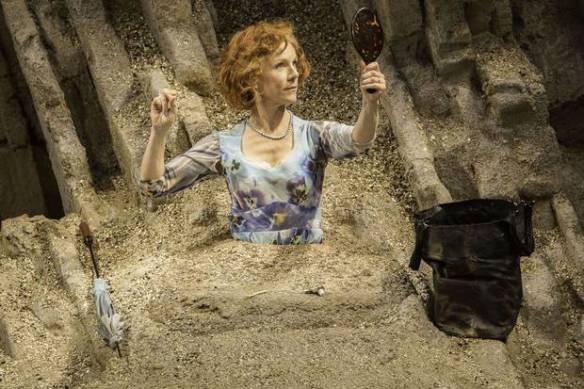
Last week I went to see Happy Days by Samuel Beckett at the Young Vic. It starred Juliet Stevenson and was directed by Natalie Abrahami.
I have to admit this wasn’t really my kind of play. I can absolutely see why others enjoy it, not least because the role is an absolute feat for any actress – I was exhausted just watching and couldn’t believe Stevenson could do this for 7 shows per week! Also the language itself follows an unusual rhythm, not unlike Molly Blooms soliloquy in Ulysees, and it’s always interesting to see how a director/actress tackles such dense monologue whilst also exploring how to interpret the physically demanding stage directions.
I went into the play having never studied it. All I knew was that the lead character is buried up to the waist (and later) neck and that there was a (often silent) off stage male character. I did know this was predominantly a monologue so I wasn’t expecting too much action on stage, in fact I was probably most excited to see how they were going to realistically bury someone up to the neck in a pile of rubble!
Watching it I understood how when this play was first performed (1963) it must have felt quit revolutionary in the way it explored relationships between women and men, how marriage can gradually suffocate us, and the affect that ageing has on a woman amongst other things. I do believe these themes are still very important and relevant, however the way in which they are presented in this play feels very dated. That is not to say if something that is ‘dated’ it cannot not still be enjoyable and inform us about a time that is different to ours, but for me, in this particular case I was wishing for something to happen that would ‘surprise’ me, or that would at least make make me feel anything but slight boredom. I’m aware that many won’t feel the same but this is just personal opinion! I came out of it feeling quite drained, and not in an good way – rather after the first fifteen minutes I realised this wasn’t for me but felt obliged to see it through to the end before passing proper judgement.
I wondered if there would be any way one could stage this play in order to make it more relevant? I don’t mean adding in a gimmick or changing the language, but is there a way that a play about a woman’s struggle within her marriage and her struggle to find a sense of self in a world where she seemingly doesn’t matter could be transferred to a modern day setting? A setting that might offer the audience a few more surprises perhaps? It’s something to think about…!

What can we learn from the past? Based on the video below I’d like to think we can learn how to put on a pretty darn epic site specific 24 hour play that hasn’t even been rehearsed! For all the techies out there, please try and see past the somewhat grainy footage and feast your eyes on the absolutely fantastic “The Warp”, a 24 hour production staged by director Ken Campbell in 1979.
It’s true that 24 hour plays are not unheard of these days, with the Old Vic staging possibly the most well known one where a collection of writers, directors and actors come together to write, direct and stage a series of short plays over 24 hours. But what is different about The Warp is that it is actually ONE play, not a collection of them. It is the story of one man and his journey into the past, future and quite frankly other worldly spheres of the universe, meeting a whole host of characters along the way (eagle eyed viewers may spot a young Jim Broadbent in the mix!)
I wondered whether anything like that could be put on today? Sadly my guess was no. My opinion (and it is only my opinion!) is that the larger, public funded theatre’s would keep a distance from something like that, it’s far too unpredictable, and dare I say it, amateurish – which is a great shame as it is that very ‘amateur’ energy and enthusiasm that makes it so special. However, I also feel that fringe companies would also be wary of attempting something on this scale for the simple fact of lack of funding and also concern for lack of audience. Ken Campbell even confirms in the video that everyone is working for free!
In the video the BBC reporter talks to Ken Campbell about the production and also his method of directing, Campbell comments that he always tries to put something funny into a scene, or at least something that at least one audience member will find amusing. He also remarks that he finds drama, or more specifically theatrical drama’s, to be a “dangerous” thing. It’s an interesting perspective from an interesting man and I can’t think of many well-known directors these days who seem to share his ‘get up and go’ and joy for making theatre. Of course, that isn’t to generalise a whole profession (including my own!!) but theatre certainly seems to be a more serious business than it did in 1979, and I’m not sure that’s necessarily a good thing.
 Spearshaker